The 49ers Quarterback Dilemma: Assessing Brock Purdy’s Prospects
October often brings themes of change and anticipation in the NFL, and this year, the arrival of Halloween adds an extra layer of mystery and suspense to San Francisco’s enduring quarterback saga. Like a recurring ghost story, the persistent cycle involving the 49ers’ quarterback position haunts the franchise each autumn, echoing through decades of transitions, each chapter marked by hope, success, and the eerie shadow of setbacks.
A Historical Overview of 49ers Quarterbacks
For over three decades, the 49ers have experienced considerable turnover at quarterback, characterized by hauntingly familiar trends. Typically, backup steps from the shadows demonstrates significant promise under the stadium lights, secures a lucrative contract, and ultimately confronts challenges that necessitate another transitional cycle as chilling as a Halloween curse.
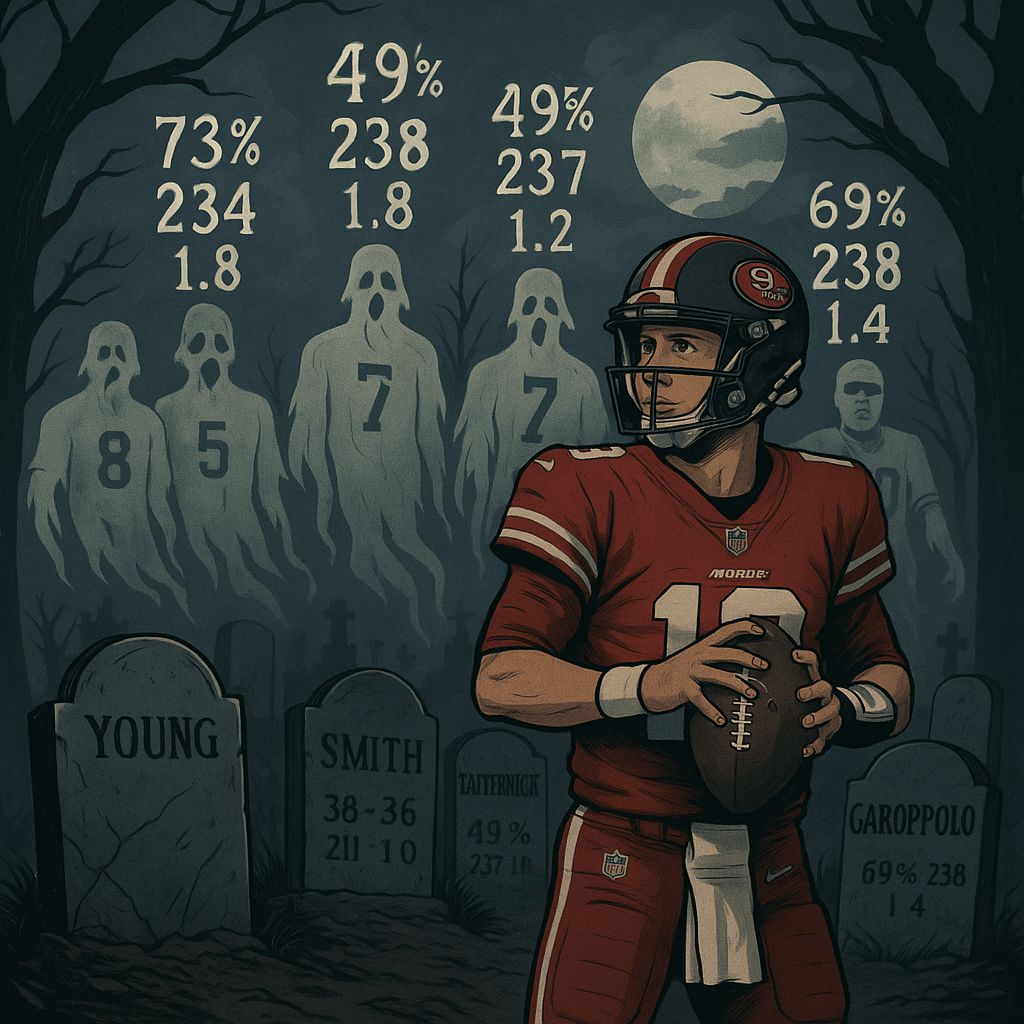
Steve Young (1991–1999): Following Joe Montana, Young became a Hall of Fame inductee, winning 73% of his games, averaging 234 yards with 1.8 touchdowns per game, and securing a Super Bowl victory. However, repeated concussions concluded his career by 1999, like a hero felled by an unseen phantom.
Jeff Garcia (1999–2003): Garcia posted eerily similar stats: 238 yards, 1.8 TDs per game, multiple Pro Bowls, and playoff appearances. Then, just like that, he was cut when the team turned to Alex Smith.
Alex Smith (2005–2012): Smith maintained a 38–36 record as a starter, averaged 211 yards and one touchdown per game, and received a contract extension in 2011, only to be succeeded midseason in 2012 by Colin Kaepernick—a transition that felt almost supernatural for fans who witnessed it.
Colin Kaepernick (2012–2016): Electrifying and dynamic, Kaepernick averaged 237 yards and 1.2 TDs per game. He led the 49ers to a Super Bowl, then signed a six-year, $115 million deal in 2014. By 2017, he was out of the NFL in one of the league’s most controversial exits.
Jimmy Garoppolo (2017–2022): Garoppolo posted a 69%-win rate, 238 yards and 1.4 touchdowns per game, reaching the Super Bowl and signing a five-year, $137 million deal before injuries and inconsistent performances affected his tenure, as if cursed by the ghosts of quarterback’s past.
Additionally, the organization’s investment in Trey Lance, involving three first-round draft picks, did not yield the desired results, adding another twist to the haunted history of San Francisco’s signal callers.
The organization’s quarterback history reflects a pattern: initial success, subsequent financial commitment, followed by decline or abrupt change—almost as though the franchise is trapped in a spooky cycle they cannot escape.
Brock Purdy’s Emergence
Brock Purdy, selected last in the 2022 NFL Draft, exceeded expectations by quickly ascending to the starting quarterback role, stepping out of the fog as the latest hope for a city accustomed to October chills. By 2024, he had led the 49ers to both an NFC Championship Game and a Super Bowl appearance, thrilling fans with gameplay that defied expectations—and perhaps the old quarterback curse.
Purdy’s performance metrics through his initial seasons include:
- A 63%-win rate
- Approximately 238 passing yards and 1.6 touchdowns per game
- Recognition as one of the league’s most efficient quarterbacks
Statistically, Purdy’s achievements align closely with those of his predecessors, suggesting that the spirits of past successes linger around Levi’s Stadium.
Injuries and Contractual Commitments
In the current NFL season, Purdy encountered an early setback with a turf toe injury and subsequent shoulder soreness, resulting in missed games. Initial assessments suggested minor issues, but subsequent developments indicated potential for a prolonged recovery—an occurrence reminiscent of previous quarterbacks’ injury trajectories, continuing the frightful trend.
In the 2025 offseason, the 49ers reinforced their commitment to Purdy through a five-year, $265 million contract extension ($181 million guaranteed, $40 million signing bonus). While his immediate salary cap impact is limited, future obligations escalate significantly, approaching $50 million annually by 2029.
Historically, similar contractual investments in Steve Young, Colin Kaepernick, and Jimmy Garoppolo were followed by periods of diminished returns due to injuries or other factors—as if the team’s fortune is written on an ancient, cobwebbed scroll.
Future Outlook
San Francisco finds itself at a familiar juncture: a promising quarterback who has demonstrated playoff capability, faced early injury challenges, and secured a substantial long-term contract. This sequence mirrors previous experiences within the franchise, evoking a sense of déjà vu that seems especially fitting during the Halloween season.
For the 49ers, the key questions are whether Purdy can sustain his performance, remain healthy, and justify the organization’s ongoing investment. Should injuries persist or performance diminish, the franchise may again need to reassess its approach at the quarterback position—risking another trip through the haunted house of roster change.
Conclusion
As the NFL season progresses and Halloween approaches, the tale of Brock Purdy and the 49ers’ quarterbacks continues to unfold with both hope and suspense. Will Purdy finally break the franchise’s eerie streak, or will the cycle repeat itself, shrouding the team in uncertainty? While statistical trends and recent developments suggest caution, the unpredictable nature of professional sports leaves room for optimism—and maybe a few treats among the tricks. Ultimately, the evolution of Purdy’s career will contribute to the ongoing story of the 49ers and their pursuit of sustained success at football’s most critical position, even as ghosts of seasons past linger on the horizon.
 Because I Have a Live Mic
Leave a comment