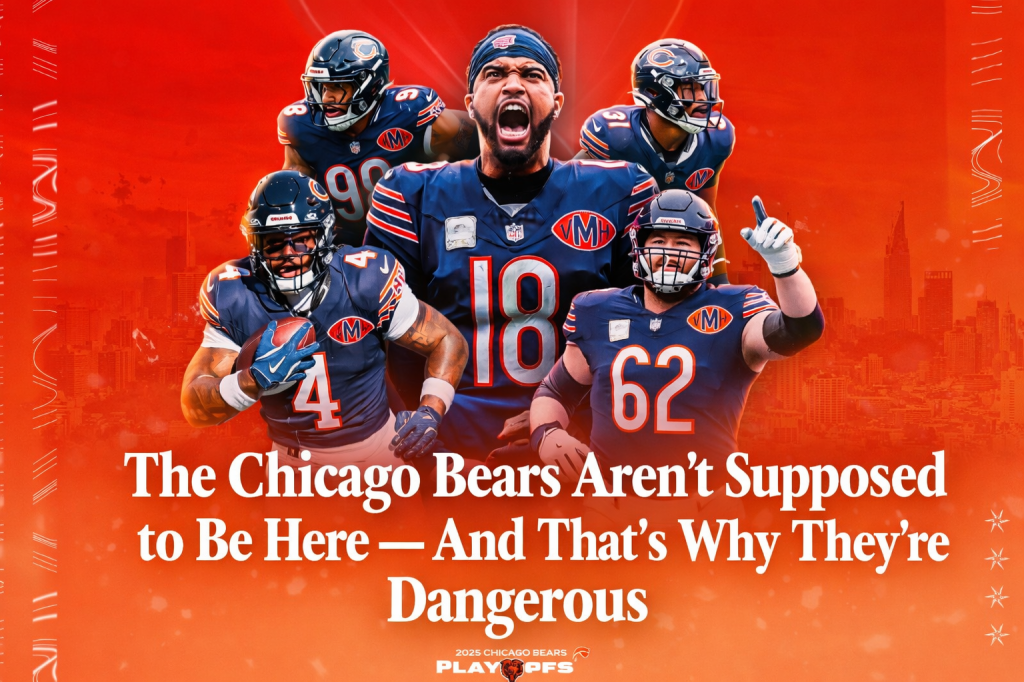
• The Chicago Bears Aren’t Supposed to Be Here — And That’s Why They’re Dangerous

    If you’re searching for a clear, convincing explanation for why the Chicago Bears are in the playoffs, you won’t find it in the standings or the box scores. Nothing about this season looks dominant. The Bears don’t overwhelm opponents. They don’t separate early, nor do they finish games with the kind of statistical authority that makes analysts comfortable. In fact, in many of the categories typically associated with playoff teams—scoring, efficiency, margin—Chicago sits near the bottom of the NFC field. And yet, here they are: still standing, still alive, and still looming as the kind of matchup no Super Bowl favorite wants to see in January.

    Why the Numbers Call Them the Worst Playoff Team

    On paper, the Bears look like they don’t belong. Chicago averages just over 20 points per game, and too many red-zone trips still end in field goals. Long drives regularly stall before delivering a knockout punch. The Bears rarely bury teams, rarely pull away, and almost never control games wire to wire. On paper, this offense hardly resembles that of a typical playoff team. That’s not disrespect — that’s math.

    If the argument against the Bears is based solely on statistics, it’s a straightforward one. On paper, Chicago’s offensive unit does little to intimidate. Averaging just above 20 points per game, the Bears lag well behind the NFC’s elite contenders. Their drives frequently begin with promise but often fail to deliver, resulting in too many field goals and not enough touchdowns, especially when they reach the red zone. For long stretches, the offense struggles to establish any true rhythm.

    However, football isn’t defined by spreadsheets—it’s shaped by moments on the field. The numbers overlook crucial elements: how and when Chicago scores, and the challenges their offense presents over the course of a full game. Unlike high-octane teams, Chicago’s offense doesn’t assert itself early. Instead, it persists, shortening games and forcing defenses into long, physically demanding possessions. These possessions may seem harmless until, unexpectedly, they become decisive. The absence of explosive plays keeps scores close, and those tight scores have a ripple effect on the opposition.

    Despite their shortcomings, the Bears’ offense is designed to thrive in these pressure situations. It doesn’t require dominance across all four quarters, nor does it need to control time of possession or score early. Instead, its focus is on keeping the game within reach until the pressure can shift in their favor.

    This approach explains why teams often leave matchups against Chicago feeling frustrated, even when they believe they should have been in control. The offense doesn’t win by statistical measures; it wins by never allowing opponents to break free.

    Undeniably, the numbers paint the Bears as a subpar playoff offense. Yet, stylistically, they are exhausting, irritating, and uncomfortable to face. In January, when expectations are high and margins for error are slim, an offense doesn’t have to be great—it just has to be present at the end.

    The Bears’ Defense: Volatility as a Weapon

    Chicago’s defense plays with an aggressive edge that borders on reckless—and that is by design. They jump passing routes, sit on offensive concepts, and entice quarterbacks into making throws that appear safe until they are not. Sometimes, this style results in costly mistakes. Other times, it changes the game with a single play.

    In the playoffs, where a single possession can determine a team’s fate, this volatility becomes a weapon. It does not have to be sustainable over four games, nor is it expected to be. The risk is inherent, but so is the reward.

    That same volatility, however, cuts both ways. High-risk, high-reward defenses rely heavily on timing, anticipation, and confidence. When everything aligns, the Bears’ defense can be suffocating in the moments that matter most. If their timing is even slightly off, their margin for error vanishes. A mistimed jump can turn into a big gain for the opponent, a baited throw that does not materialize leads to an easy completion, and a missed tackle can turn aggressive intent into a long touchdown.

    Against disciplined quarterbacks who avoid the traps, this defensive style can backfire. Opposing drives are extended, the clock continues to run, and the Bears’ defense is forced to remain on the field longer than intended. The chaos that typically gives them an edge can quickly become a liability, resulting in player fatigue.

    This constant tension between brilliance and collapse defines the Bears’ defense. Depending on which side of the risk manifests first, they can be a nightmare matchup or a fragile unit. Their willingness to gamble is both their greatest strength and their biggest vulnerability in the postseason.

    Late-Game Execution and the Williams Effect

    Under first-year head coach Ben Johnson, the Chicago Bears have adopted a deliberate shift in offensive philosophy that prioritizes winning late rather than dominating early. Instead of chasing explosive plays or fast starts, the Bears operate with patience, risk management, and field-position awareness. Early in games, the offense often accepts punts, avoids forcing throws, and plays conservatively—sometimes to a frustrating degree. This approach explains much of the perceived inconsistency in both the offense and quarterback Caleb Williams.

    Statistically, the results can look underwhelming. Big plays are limited, early scoring spurts are rare, and long stretches feel disjointed. For Williams, whose strengths lie in creativity, instinct, and off-script brilliance, this structure can make his performance appear uneven. Some of that inconsistency is natural for a young quarterback still learning timing, reads, and discipline. But part of it is intentional. The Bears are not asking Williams to win games in the first half; they are asking him to protect them until the moment matters most.

    That moment typically arrives late. As defenses tighten and games narrow, Chicago loosens the reins. Structure gives way to instinct, and Williams’ improvisational ability becomes an asset rather than a risk. His late-game scrambles, off-platform throws, and rapid decision-making have defined several key wins. He doesn’t need four perfect quarters—he needs one decisive drive.

    This reliance on late-game heroics is thrilling but fragile. It’s not a sustainable formula for a championship run, especially with a young quarterback. Still, it reflects meaningful progress. The Bears are learning how to win close games before learning how to dominate. Williams is developing game management skills before being handed full control.

    Combined with a high-risk, opportunistic defense, this approach makes Chicago an uncomfortable postseason opponent. Their flaws may eventually catch up to them—but not before they force opponents into stressful, unpredictable games.

    The 2025 Chicago Bears: A Nexus Team

    In the end, the 2025 Chicago Bears aren’t built to dominate January. They’re built to disturb it. Their defense gambles. Their quarterback wavers — until he doesn’t. Their offense survives just long enough to keep belief alive. None of it is sustainable, and none of it is accidental. This is what a team looks like when it’s no longer afraid to lose but not yet burdened by expectations. A team in between. A Nexus team. And in the playoffs, where seasons can hinge on a single mistake, that space between bad and good is often the most dangerous place to be.
  • The Haunted History of 49ers QBs

    The 49ers Quarterback Dilemma: Assessing Brock Purdy’s Prospects

    October often brings themes of change and anticipation in the NFL, and this year, the arrival of Halloween adds an extra layer of mystery and suspense to San Francisco’s enduring quarterback saga. Like a recurring ghost story, the persistent cycle involving the 49ers’ quarterback position haunts the franchise each autumn, echoing through decades of transitions, each chapter marked by hope, success, and the eerie shadow of setbacks.

    A Historical Overview of 49ers Quarterbacks

    For over three decades, the 49ers have experienced considerable turnover at quarterback, characterized by hauntingly familiar trends. Typically, backup steps from the shadows demonstrates significant promise under the stadium lights, secures a lucrative contract, and ultimately confronts challenges that necessitate another transitional cycle as chilling as a Halloween curse.

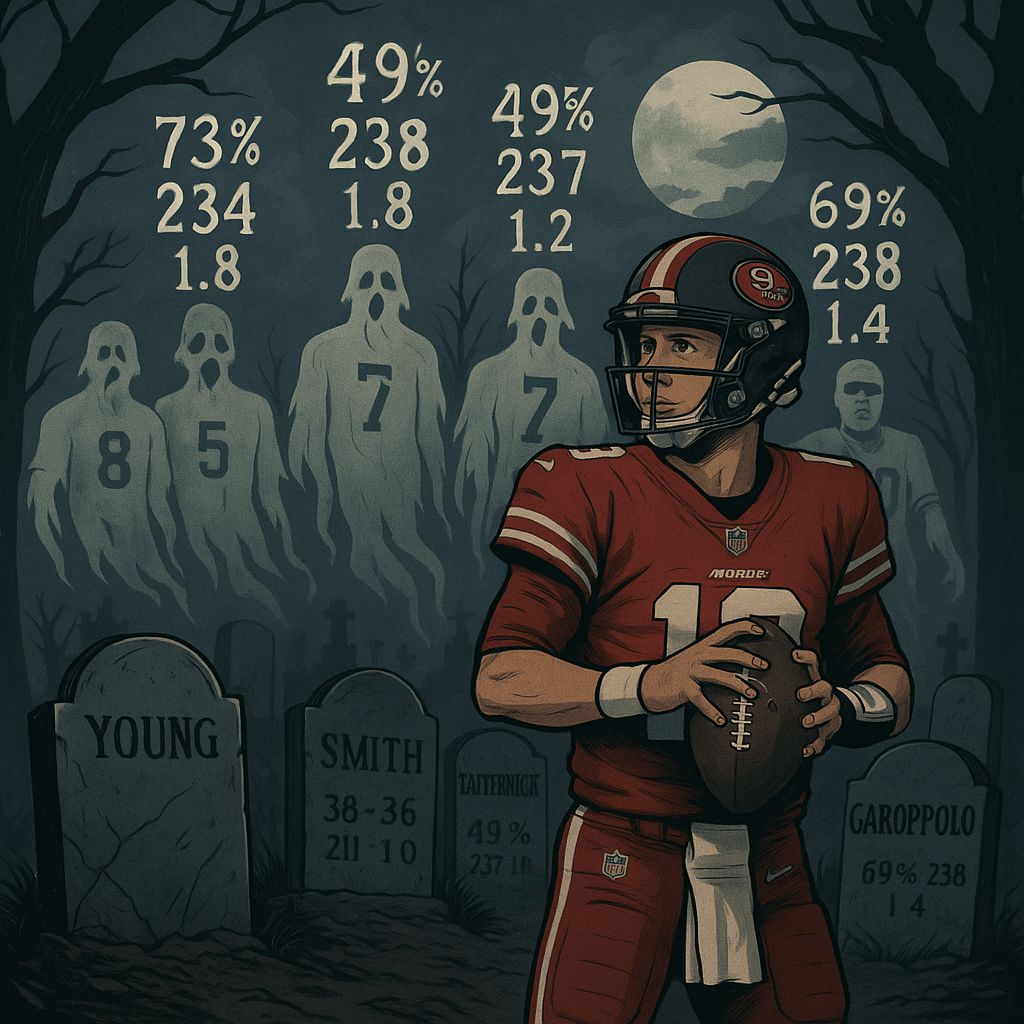
    Steve Young (1991–1999): Following Joe Montana, Young became a Hall of Fame inductee, winning 73% of his games, averaging 234 yards with 1.8 touchdowns per game, and securing a Super Bowl victory. However, repeated concussions concluded his career by 1999, like a hero felled by an unseen phantom.

    Jeff Garcia (1999–2003): Garcia posted eerily similar stats: 238 yards, 1.8 TDs per game, multiple Pro Bowls, and playoff appearances. Then, just like that, he was cut when the team turned to Alex Smith.

    Alex Smith (2005–2012): Smith maintained a 38–36 record as a starter, averaged 211 yards and one touchdown per game, and received a contract extension in 2011, only to be succeeded midseason in 2012 by Colin Kaepernick—a transition that felt almost supernatural for fans who witnessed it.

    Colin Kaepernick (2012–2016): Electrifying and dynamic, Kaepernick averaged 237 yards and 1.2 TDs per game. He led the 49ers to a Super Bowl, then signed a six-year, $115 million deal in 2014. By 2017, he was out of the NFL in one of the league’s most controversial exits.

    Jimmy Garoppolo (2017–2022): Garoppolo posted a 69%-win rate, 238 yards and 1.4 touchdowns per game, reaching the Super Bowl and signing a five-year, $137 million deal before injuries and inconsistent performances affected his tenure, as if cursed by the ghosts of quarterback’s past.

    Additionally, the organization’s investment in Trey Lance, involving three first-round draft picks, did not yield the desired results, adding another twist to the haunted history of San Francisco’s signal callers.

    The organization’s quarterback history reflects a pattern: initial success, subsequent financial commitment, followed by decline or abrupt change—almost as though the franchise is trapped in a spooky cycle they cannot escape.

    Brock Purdy’s Emergence

    Brock Purdy, selected last in the 2022 NFL Draft, exceeded expectations by quickly ascending to the starting quarterback role, stepping out of the fog as the latest hope for a city accustomed to October chills. By 2024, he had led the 49ers to both an NFC Championship Game and a Super Bowl appearance, thrilling fans with gameplay that defied expectations—and perhaps the old quarterback curse.

    Purdy’s performance metrics through his initial seasons include:

    • A 63%-win rate
    • Approximately 238 passing yards and 1.6 touchdowns per game
    • Recognition as one of the league’s most efficient quarterbacks

    Statistically, Purdy’s achievements align closely with those of his predecessors, suggesting that the spirits of past successes linger around Levi’s Stadium.

    Injuries and Contractual Commitments

    In the current NFL season, Purdy encountered an early setback with a turf toe injury and subsequent shoulder soreness, resulting in missed games. Initial assessments suggested minor issues, but subsequent developments indicated potential for a prolonged recovery—an occurrence reminiscent of previous quarterbacks’ injury trajectories, continuing the frightful trend.

    In the 2025 offseason, the 49ers reinforced their commitment to Purdy through a five-year, $265 million contract extension ($181 million guaranteed, $40 million signing bonus). While his immediate salary cap impact is limited, future obligations escalate significantly, approaching $50 million annually by 2029.

    Historically, similar contractual investments in Steve Young, Colin Kaepernick, and Jimmy Garoppolo were followed by periods of diminished returns due to injuries or other factors—as if the team’s fortune is written on an ancient, cobwebbed scroll.

    Future Outlook

    San Francisco finds itself at a familiar juncture: a promising quarterback who has demonstrated playoff capability, faced early injury challenges, and secured a substantial long-term contract. This sequence mirrors previous experiences within the franchise, evoking a sense of déjà vu that seems especially fitting during the Halloween season.

    For the 49ers, the key questions are whether Purdy can sustain his performance, remain healthy, and justify the organization’s ongoing investment. Should injuries persist or performance diminish, the franchise may again need to reassess its approach at the quarterback position—risking another trip through the haunted house of roster change.

    Conclusion

    As the NFL season progresses and Halloween approaches, the tale of Brock Purdy and the 49ers’ quarterbacks continues to unfold with both hope and suspense. Will Purdy finally break the franchise’s eerie streak, or will the cycle repeat itself, shrouding the team in uncertainty? While statistical trends and recent developments suggest caution, the unpredictable nature of professional sports leaves room for optimism—and maybe a few treats among the tricks. Ultimately, the evolution of Purdy’s career will contribute to the ongoing story of the 49ers and their pursuit of sustained success at football’s most critical position, even as ghosts of seasons past linger on the horizon.

  • From Soldier Field to Arlington Heights: How Stadium Dreams Keep Sinking the Bears

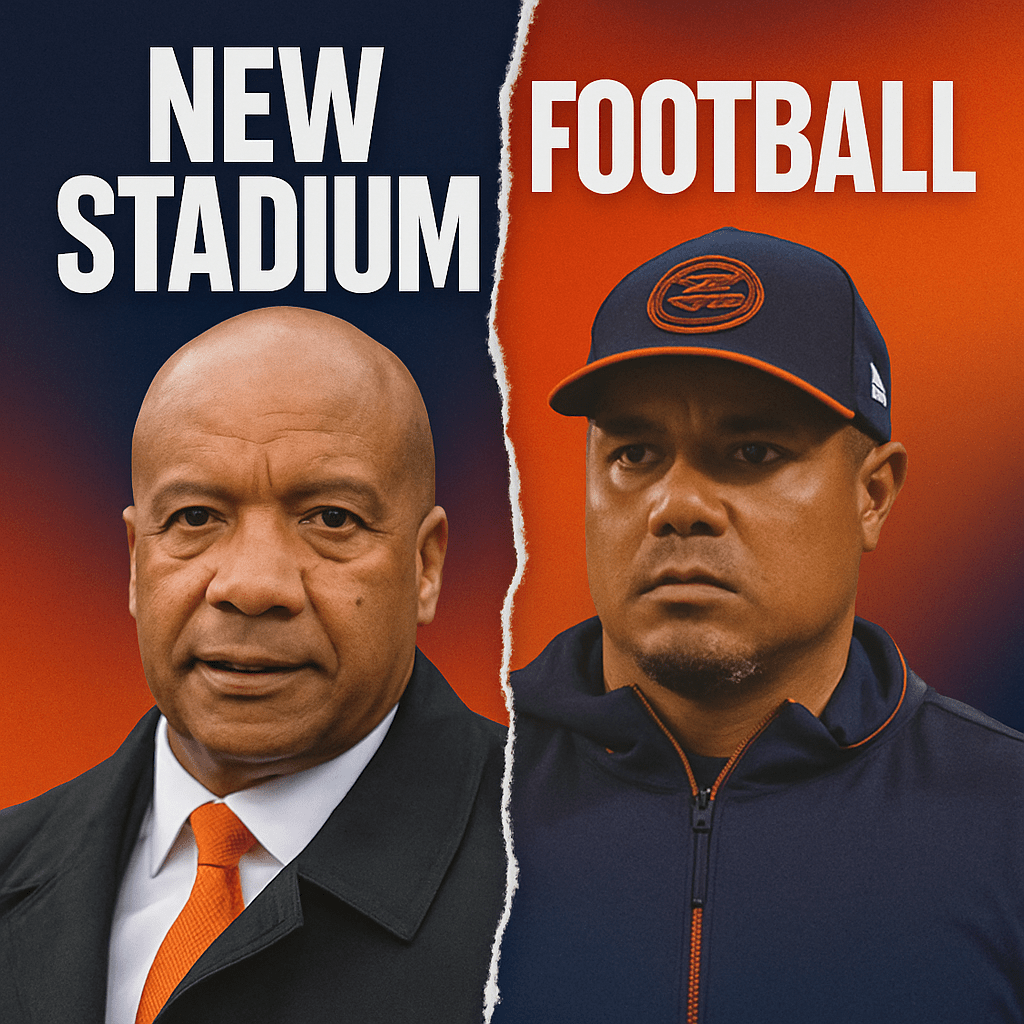
    The Chicago Bears’ challenges extend beyond missed tackles, coaching decisions, or the development of a new quarterback. These are merely visible effects of a deeper organizational division. The franchise is currently being shaped by two distinct strategic visions: Kevin Warren, President and CEO, focusing on the establishment of a new stadium, and Ryan Poles, General Manager, endeavoring to construct a competitive team roster.

    Both individuals possess considerable expertise in their respective areas; however, their concurrent initiatives have resulted in ambiguity concerning the team’s priorities. Organizational attention appears divided between infrastructure projects and football operations, with an emphasis on long-term business ventures over immediate team performance. Unless these priorities are reconciled, the Bears may struggle to progress competitively.

    Kevin Warren: Strategic Focus on Infrastructure

    Appointed in 2023, Kevin Warren was selected not solely for his administrative skills, but for his track record in developing landmark sports facilities, exemplified by Minnesota’s U.S. Bank Stadium. His mandate is to secure a new stadium project in Chicago—a move anticipated to increase revenue streams and enhance franchise valuation. While this approach aligns with ownership’s business objectives, it may be perceived by supporters as prioritizing future gains over current competitiveness.

    Ryan Poles: Building Team Competitiveness

    Tasked with revitalizing the player roster since 2022, Ryan Poles has implemented foundational changes, acquired draft assets and positioning the team to maximize the early career of quarterback Caleb Williams. Poles’ plan centers on cultivating a resilient, well-balanced team within the financial advantages afforded by Williams’ rookie contract. However, the window for such a transformation is narrow, and any delays threaten the effectiveness of this strategy.

    Divergent Timelines and Metrics

    This divergence manifests in contrasting time horizons: Warren’s objectives extend toward long-term infrastructure milestones, while Poles must demonstrate success in the short term, particularly before key player contracts require renewal. Their metrics also differ—organizational value versus on-field results—contributing to the current lack of alignment that affects overall team performance.

    Organizational Performance Since Leadership Changes

    Since Warren assumed leadership in April 2023, the Bears have compiled a combined 12–22 record (.353-win percentage), showing only marginal improvement from past seasons. The trajectory suggests a need for cohesive strategy, as operational focus remains unclear to both internal stakeholders and external audiences.

    Historical Context and Lessons Learned

    The Bears have previously encountered similar disruptions during the 2002 Soldier Field renovation, which coincided with a substantial decrease in performance and fan engagement. Even after stadium completion, it took several years for the team to recover competitively. These historical lessons highlight complications that can arise when organizational priorities become fragmented.

    Impact of Divided Focus

    A split vision at the executive level permeates all facets of the organization, affecting player morale, recruitment efforts, and public perception. Comparative examples across the league illustrate that successful franchises balance infrastructure development with decisive investments in team building, underscoring the importance of unified leadership.

    For the Chicago Bears to realize their potential, alignment between the strategic objectives of executive leadership and football operations is imperative. Whether the focus is infrastructure or roster construction, integration of these goals will be essential for the franchise to deliver sustained success and restore stakeholder confidence. Without such cohesion, the Bears risk continued underperformance and unrealized opportunities.

  • Is Justin Herbert Overrated or Just Undervalued
    The Gifted Quarterback in a Results-Driven League

    The NFL is a strange place. Talent is easy to spot, but respect? That comes and goes. Nobody shows that paradox more than Justin Herbert. On paper, he’s right there with the league’s best. Year after year, he puts up big-time numbers, throwing darts that make highlight reels every Sunday. But for some reason, the narrative around Herbert always feels colder than his stats.

    Here’s the double standard: when Joe Burrow or Josh Allen fill up the box score in a loss, the blame usually shifts elsewhere — bad defense, missed coaching calls, injuries. When Herbert does the same? It’s “empty stats.” His production gets torn apart for what it doesn’t mean instead of what it does.

    And of course, the playoff record is the big stain. Herbert’s 0–2 in the postseason, and both losses were brutal. The blown 27–0 lead against the Jaguars has become shorthand for his career criticism, and that four-interception meltdown against Houston didn’t help. In the NFL, January isn’t just playoff time — it’s judgment time. Until Herbert changes that story, the shadow of those games will stick.

    Against the league’s heavyweights, it’s more of the same. He’s 3–7 against Patrick Mahomes, winless against Josh Allen, and his postseason résumé doesn’t come close to Burrow’s. It doesn’t matter that his efficiency and arm talent are elite — in the NFL, the only stat that really counts is wins.

    And then there’s his personality. Herbert isn’t flashy, doesn’t trash talk, doesn’t feed the media viral moments. He’s calm, businesslike, and focused on football. That should be respected — but in today’s hot-take culture, it gets spun into “he doesn’t have fire” or “he’s not a leader.” Pair that with the Chargers’ reputation for dysfunction and a small fan base, and Herbert becomes an easy target.

    The truth is simple: Herbert’s talent isn’t up for debate. But the NFL doesn’t crown you for talent — it crowns you for wins. Until he breaks through in the playoffs and takes down the league’s best, the hate isn’t going anywhere. The flip side? The moment he does, those same voices that doubt him now will call him elite. That’s the NFL cycle — harsh, reactionary, but quick to change once the scoreboard does.

  • Welcome to WordPress! This is your first post. Edit or delete it to take the first step in your blogging journey.